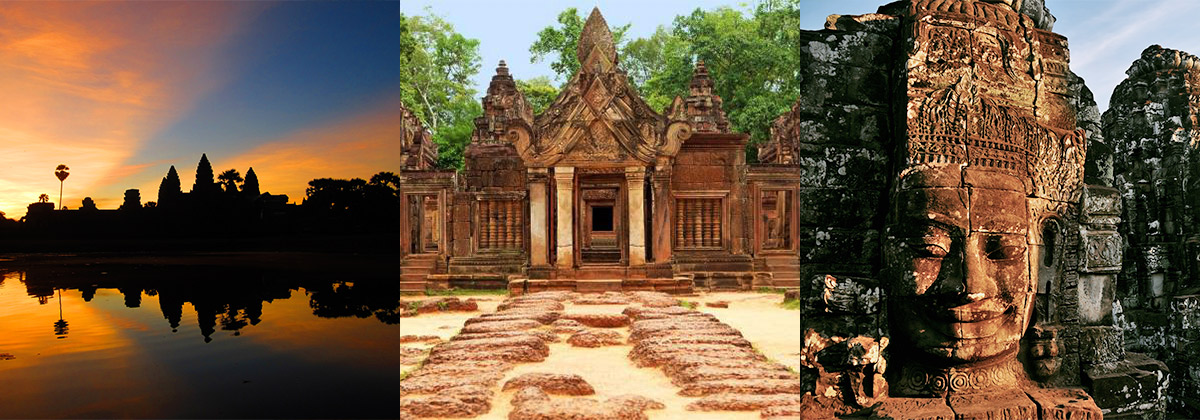
A small island temple located in the middle of the last baray to be constructed by a Khmer king in the Angkor area (Preah Khan Baray or Jayatataka). The central temple sits at the axis of a cross or lotus pattern of eight pools. Originally known as Rajasri, Neak Pean took its modern appellation, which means ‘coiled serpents,’ from the encoiled nagas that encircled the temple. The temple is faced by a statue of the horse, Balaha, saving drowning sailors. Though originally dedicated to Buddha, Neak Pean contains several Hindu images. Neak Pean may have served an absolution function, and the waters were thought to have healing properties. During the dry season when the water is low, check out the animal and human headwater spouts at the outside center of each pool. Neak Pean is most photogenic in the wet season when the pools are full.
Neak Pean or Neak Poan at Angkor, Cambodia is an artificial island with a Buddhist temple on a circular island in Preah Khan Baray built during the reign of King Jayavarman VII. 389 It is the "Mebon" of the Preah Khan baray (the "Jayatataka" of the inscription).
Some historians believe that Neak Pean represents Anavatapta,174 a mythical lake in the Himalayas whose waters are thought to cure all illness.124–125 The name is derived from the sculptures of snakes (Nāga) running around the base of the temple structure, neak being the Khmer rendering of the Sanskrit naga. "They are Nanda and Upananda, two nagas traditionally associated with Lake Anavatapta."
Neak Pean was originally designed for medical purposes (the ancients believed that going into these pools would balance the elements in the bather, thus curing disease); it is one of the many hospitals that Jayavarman VII built. It is based on the ancient Hindu belief of balance. Four connected pools represent Water, Earth, Fire and Wind. Each is connected to the central water source, the main tank, by a stone conduit "presided over by one of Four Great Animals (maha ajaneya pasu) namely Elephant, Bull, Horse, and Lion, corresponding to the north, east, south, and west quarters....The stone conduits in the little pavilions are fashioned to represent the heads of the Four Great Animals...the only exception being that on the east, which represents a human head instead of a bull's." Originally, four sculptures stood on the floor of the lake. The only remaining statue is that of the horse Balaha, a form of the bodhisattva Avalokitesvara, saving sailors from the ogresses of Tamradvipa. The temple on the lake was originally dedicated to Avalokitesvara. Willetts believed that "this is Jayavarman as he would have wished to have appeared to his people"
Zhou Daguan refers to Neak Pean in his visit to Angkor in the late 13th century.

Afternoon, transfer to culture village – the unique open-air museum contains life-size exhibits representing the various ethnicities and cultures in Cambodia. Attractions include replicas of ...
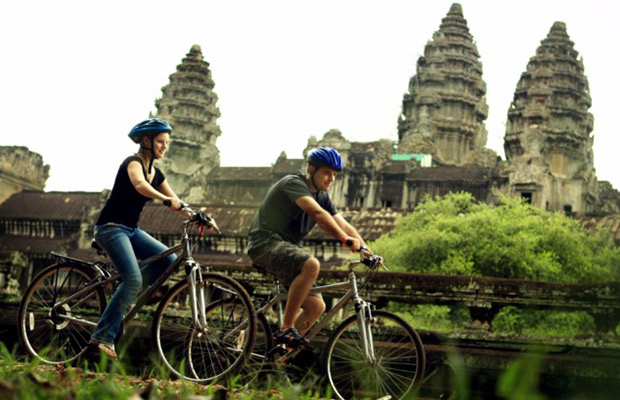
It’s the perfect way for getting around the temples. Taking your bike into the historical park isn’t a problem and you don’t have to pay anything for it. Those faces just rise out of every ...
For active couples who really like to discover Cambodia in only 18 days. A romantic tour, but not only sitting by the pool or lying on the beach. By bike, cyclo, jeep, ferry, trekking and a tuk-tuk, ...

After a full day of touring the temples of Angkor, enjoy a relaxed evening of entertainment and delicious food. With this Apsara Theatre ticket you can experience traditional Khmer culture through ...

Devote an entire day to exploring the incredible temples at Angkor Wat and Angkor Thom under the leadership of a local, English-speaking guide. Discover the UNESCO-listed ruins at Angkor Wat and the ...
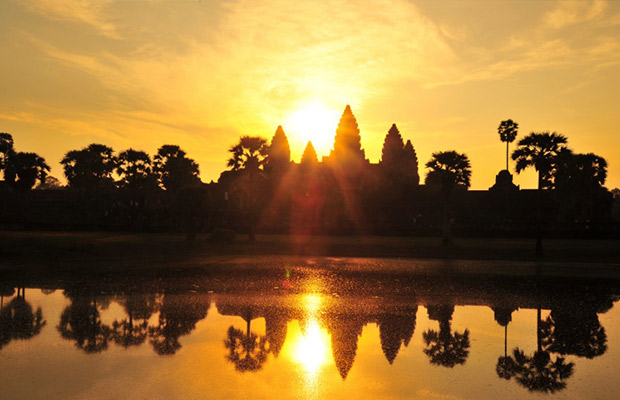
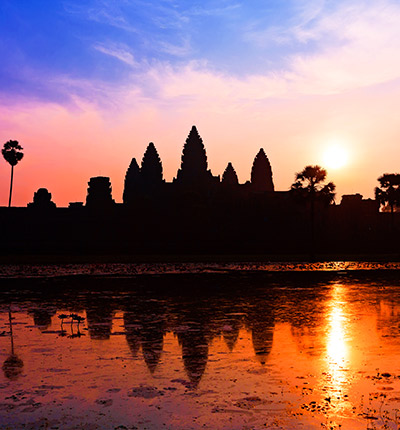
This sunrise & sunset tour will bring you to have an experience of Angkor Wat sunrise and Bakheng Sunset, the history, cultural, beauty, life style and its unique charm, a boat to floating village ...

Salakamreuk Road, Salakamreuk Commune, Siem Reap, Cambodia
Best for Traveller!
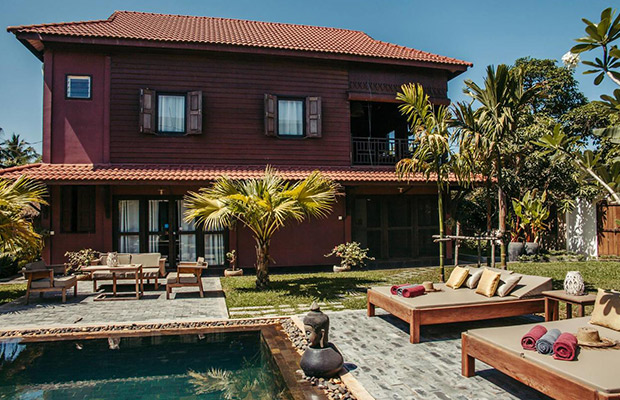
Set in Siem Reap, House Jane offers accommodation nestled within a tropical garden featuring an outdoor swimming pool and private spa services. Free WiFi is offered throughout the property and there is free parking on-site.
The vibrant Pub Street is 1.5 km from the property. Angkor Wat is 8 km from House Jane. The nearest airport is Siem Reap - Angkor International Airport is a 15-minute drive from House Jane, and the property offers a free airport pick-up service.
Featuring a blend of contemporary design and traditional Khmer architecture, some units feature a dining area and/or terrace that opens up to views. There is also a kitchen in some of the units, fitted with a refrigerator. Every unit has an en suite bathroom with a walk-in rain shower, hairdryer and free toiletries. Free private parking is available at the villa.
Free use of bicycles is available for guests who wish to explore the surrounding area. House Jane provides private car hire with a driver at an additional cost.
House Jane serves a variety of breakfast items as well as a three-course dinner menu.
This is our guests' favourite part of Siem Reap, according to independent reviews.
We speak your language!

St. 27, Wat Bo Village, Sala Kamreuk Commune, Siem Reap, Cambodia., Siem Reap, Cambodia
Best Deal!
Featuring free WiFi throughout the property, Apsara Residence offers accommodations in Siem Reap. It is 400 m away from Pub Street, Old Market and the night market. The hotel has an outdoor pool, and guests can enjoy a drink at the bar. Free private parking is available on-site.
Every room is fitted with a 32-inch flat-screen TV that comes with cable channels. Some rooms feature a seating area to relax in after a busy day. A terrace or balcony are featured in certain rooms. Rooms include a private bathroom equipped with shower facilities. For your comfort, you will find bath robes and slippers.
A tour desk and bike and car hires are available at this hotel, and the area is popular for walking and cycling.
Angkor Wat is 4.3 mi from Apsara Residence, while Angkor Trade Center is 200 m away. The nearest airport is Siem Reap - Angkor International Airport, which is 5 mi from Apsara Residence. Airport transfers and shuttle services are available upon request.
This is our guests' favorite part of Siem Reap, according to independent reviews.
This property also has one of the top-rated locations in Siem Reap! Guests are happier about it compared to other properties in the area.
Couples in particular like the location – they rated it 9.6 for a two-person trip.
This property is also rated for the best value in Siem Reap! Guests are getting more for their money when compared to other properties in this city.
We speak your language!
Street 27, Wat Bo Village, Siem Reap, Cambodia
Best Seller!
Located in Siem Reap, Central Corner d'Angkor features an outdoor swimming pool and a garden. Featuring a terrace, this property is set near attractions such as King's Road Angkor. The property has a restaurant and Pub Street is less than 1 km away.
Guest rooms at the hotel come with a seating area, a flat-screen TV with satellite channels and a private bathroom with free toiletries and a shower. The units at Central Corner d'Angkor include air conditioning and a desk.
A continental breakfast is available each morning at the property.
Bike hire and car hire are available at this hotel and the area is popular for cycling.
Speaking English and Khmer, staff at the 24-hour front desk can help you plan your stay.
Popular points of interest near the accommodation include Old Market, Angkor Trade Centre and Platinum Cineplex Siem Reap. The nearest airport is Siem Reap - Angkor International, 14 km from Central Corner d'Angkor, and the property offers a free shuttle service.
This is our guests' favourite part of Siem Reap, according to independent reviews.
This property also has one of the best-rated locations in Siem Reap! Guests are happier about it compared to other properties in the area.
Couples particularly like the location — they rated it 9.4 for a two-person trip.
This property is also rated for the best value in Siem Reap! Guests are getting more for their money when compared to other properties in this city.
We speak your language!
10 Makara, Sala Komreuk, Siem Reap, Siem Reap, Cambodia
Best Location!
One of our top picks in Siem Reap.
Located in the center of Siem Reap, Aster Vila offers air-conditioned accommodations equipped with a LED TV and free WiFi. This family-run hotel is a 15-minute walk from Pub Street and a 8-minute drive from Angkor Night Market.
The villa is equipped with a refrigerator, coffee facilities, bottled water and linens.
An activity in the surrounding area includes biking and the property offers free bike rental service for guests.
Angkor Wat is a 20-minute drive from the villa. Siem Reap - Angkor International Airport is a 25-minute drive from the property.
This is our guests' favorite part of Siem Reap, according to independent reviews.
Couples in particular like the location – they rated it 8.4 for a two-person trip.
This property is also rated for the best value in Siem Reap! Guests are getting more for their money when compared to other properties in this city.
We speak your language!
Wat Damnak village, Old Market Areas, Siem Reap, Cambodia
Best for Traveller!
Located in the heart of Siem Reap, Chronicle Angkor Hotel offers 14 suites tastefully designed in a handcrafted stonework decor. Just 400 m from Angkor Night Market and 300 m from the vibrant Pub Street, guests can enjoy meals at the in-house restaurant or indulge in massage treatments. Free WiFi is available throughout the property. Staff are able to converse in Chinese, Khmer and English.
Every suite comes with air conditioning, a flat-screen TV with satellite channels and a tea/coffee making facilities. Certain suites offer a seating area and a private balcony where guests can enjoy views of the city. All suites feature an en suite bathroom fitted with shower facilities. Extras include bathrobes, slippers and free toiletries.
Guests can approach a 24-hour front desk with tour arrangements and ticketing services. Guests can enjoy swimming at the outdoor pool or make use of a business centre. Union Pay is accepted at the property.
A selection of Cambodian and International dishes can be enjoyed at Sankya's Restaurant. Guests can also have drinks at the on-site bar.
The UNESCO World Heritage Site of Angkor Wat is 7.5 km away from the property, while Siem Reap - Angkor International Airport is 9 km away. The hotel offers complimentary pickup services from the airport, a bus station or a ferry dock.
This is our guests' favourite part of Siem Reap, according to independent reviews.
This property also has one of the best-rated locations in Siem Reap! Guests are happier about it compared to other properties in the area.
Couples particularly like the location — they rated it 9.6 for a two-person trip.
This property is also rated for the best value in Siem Reap! Guests are getting more for their money when compared to other properties in this city.
We speak your language!
Teuk Vil commune, National Road 6, Siem Reap, Cambodia
Best for Traveller!
Set in Siem Reap, La Renaissance Boutique offers 4-star accommodation with water sports facilities, free bikes and an outdoor swimming pool. With a fitness centre, the 4-star hotel has air-conditioned rooms with free WiFi. Chinese cuisine is served at the restaurant.
All guest rooms at the hotel feature a flat-screen TV with satellite channels, DVD Player, and a private bathroom with a bidet and free toiletries. Some rooms are fitted with a kitchen with a fridge. The rooms are equipped with a seating area.
A continental breakfast is available every morning at La Renaissance Boutique.
The accommodation offers a terrace. Cycling is among the activities that guests can enjoy near La Renaissance Boutique.
A business centre and a bicycle rental service are also offered by the hotel. Staff at La Renaissance Boutique are always available to provide advice at the reception.
Pub Street is 9 km from the accommodation. Siem Reap - Angkor International Airport is 3 km away.
We speak your language!
Being the locals, we know the true value of our land. We always listen and arrange everything as your desire. Please kindly send us whatever about your trip,we will send you best offers quickly.






Guest Name: Mr. José Monteiro
Country: Brazil
City: Rio de Janeiro
N.of Person: Hotel lotus blanc resort angkor pax
Travel date: 2026-11-28
Booked: Angkor Stunning Hot Air Balloon
Tour Style: Tour Activities
Duration: 30 Mins